Cooking classes focus on healthier-for-you recipes
By Ilene Schneider
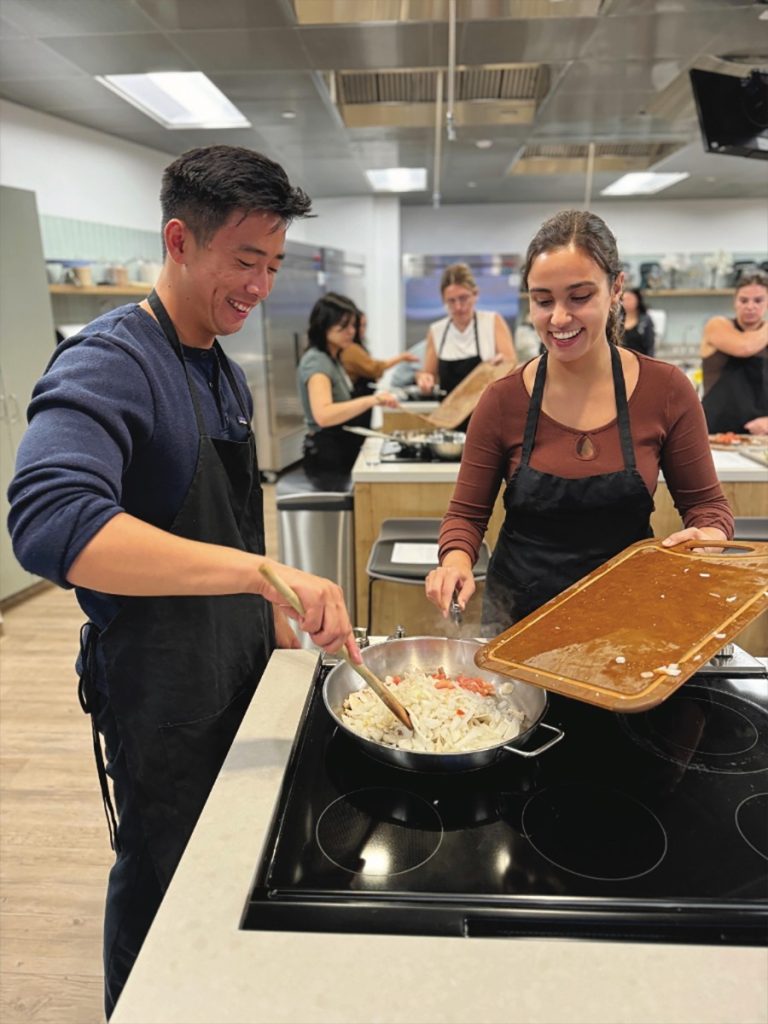
The adage “You are what you eat” takes on new meaning at UC Irvine’s Susan Samueli Integrative Health Institute. Participating in a class recently in the high-tech kitchen there proved that ingredients and cooking methods can make all the difference in maintaining a healthy diet that’s also enjoyable.
In the class on Mediterranean cooking, I was surprised to learn that a staple in my home – shawarma (see recipe) – could be made healthier by using chicken instead of lamb, baking instead of frying and choosing spices without preservatives. Even the baklava had fewer fattening ingredients while still tasting great.
Part of the institute’s mission is providing services to encourage optimal health in the community. SSIHI seeks to bridge the gap between what doctors learn about nutrition in medical school and what people need to know about making healthy diet modifications.
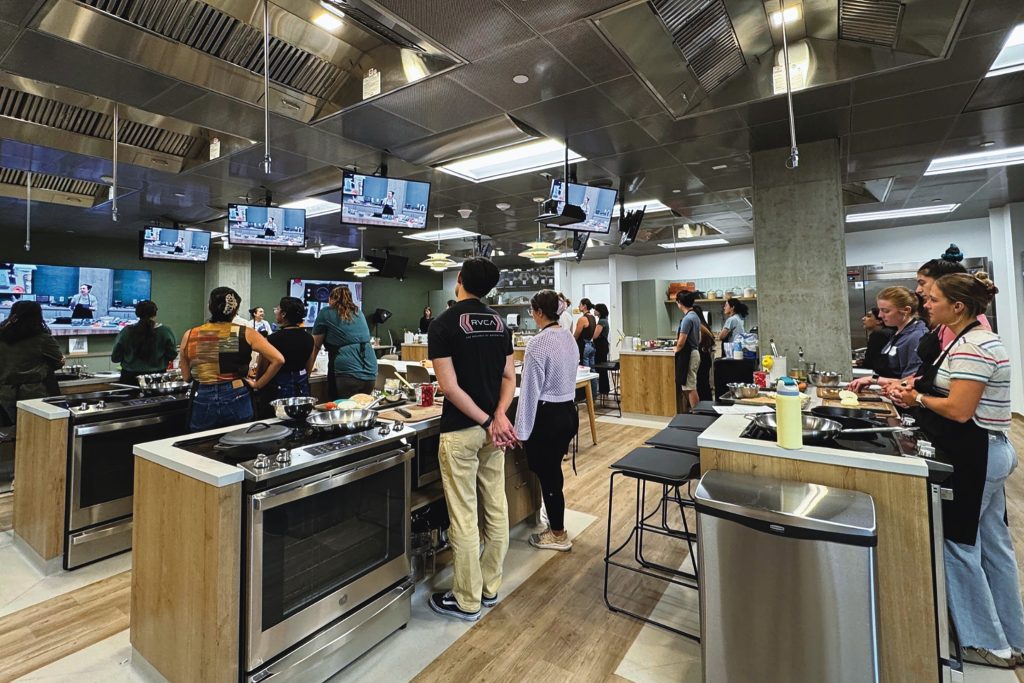
Opened two years ago, the institute’s Mussallem Nutritional Education Kitchen, a state-of-the-art teaching facility, has become a nexus for educating doctors, medical students and patients on how to prepare meals that, according to SSIHI, “please the palate and promote culinary medicine.”
Directing the program is executive chef Jessica VanRoo, who was born in Wisconsin and raised in the vibrant food hub of Taiwan. A globe-trotter with a palate for international flavors, VanRoo has cultivated an eclectic mix of culinary tastes and says she “found a passion for teaching about food” because “food connects with everybody and connects us all.”
The kitchen has eight individual cooking stations equipped with an oven, a stove, a sink and drawers full of the most up-to-date kitchen tools. Each station has an open view of the entire room; even the hoods that cover them offer unobstructed sightlines to the instructor.
Further enhancing the learning experience, every station has its own audiovisual display to enable participants to see up close and in detail what the teacher is cooking or preparing. The kitchen space also has broadcasting capabilities to engage with participants who are unable to attend in person.
The program was opened to the public to “inspire integrative, whole-person health and live up to its communitywide focus,” VanRoo says. Now, with the assistance of health coach and educator Sarah Meier, five classes per week are offered to doctors, students, patients and members of the public.
“In the community classes, people want to learn to cook healthy, delicious meals in an environment where there is science-based research,” VanRoo says. “We teach people how to make foods that they might eat in a restaurant or get out of a package, but they learn how to make them in a healthy way at home. Most people find that they love to cook.”
Initially, these classes posed a different kind of challenge, she notes, because she had to figure out what the public wanted to learn about healthy cooking. There have been classes addressing specific nutrients for those with certain health conditions (like diabetes, Crohn’s disease and cancer) and others on plant-based foods. There’s even one on knife skills to help budding chefs prep wholesome meals.
My Mediterranean cooking classmates were quick to suggest ideas for future sessions, including healthy menus for brunch and appetizers. Says VanRoo: “As an instructor, I’m constantly learning.”
For the basis of another class, doctors involved in the program wanted to emphasize the health benefits of mushrooms, so VanRoo made them look and taste like scallops by cutting them in the right shape, boiling them, searing them with nori and kelp, and serving them with a vegetarian oyster sauce or fish sauce.
Yet another class, The Picky Eater Playbook: Turning “No, Thanks” Into “More, Please!,” makes better-for-you food look and taste like less healthy options, with participants learning to make creamy tofu Alfredo pasta, veggie tater tots, homemade hidden veggie chicken nuggets and ketchup, and chocolate brownie bites.
If there’s a way to make healthy food taste great, the kitchen will find it.
Thoroughly mix all ingredients except the chicken in a bowl.
Place the chicken in the bowl and rub with the marinade ingredients. Set aside to marinate for 2 hours.
Preheat oven to 400 degrees and line a baking sheet with parchment.
Heat a cast iron pan or grill to medium high. Cook or grill the meat, flipping it as needed to brown nicely. Place on the baking sheet, reduce oven temperature to 350 degrees and cook in oven for 10 minutes or until cooked through to an internal temperature of 165 degrees.
Shred the chicken, cutting as fine as possible. After cutting, you can place it under the broiler to create crispier pieces.
Serve with mujadara and yogurt sauce if desired.
Take a Cooking Class
Alumni are welcome to attend nutritional health and education classes with UC Irvine Susan Samueli Integrative Health Institute’s Executive Chef Jessica VanRoo. Find more information and sign up for upcoming classes here.