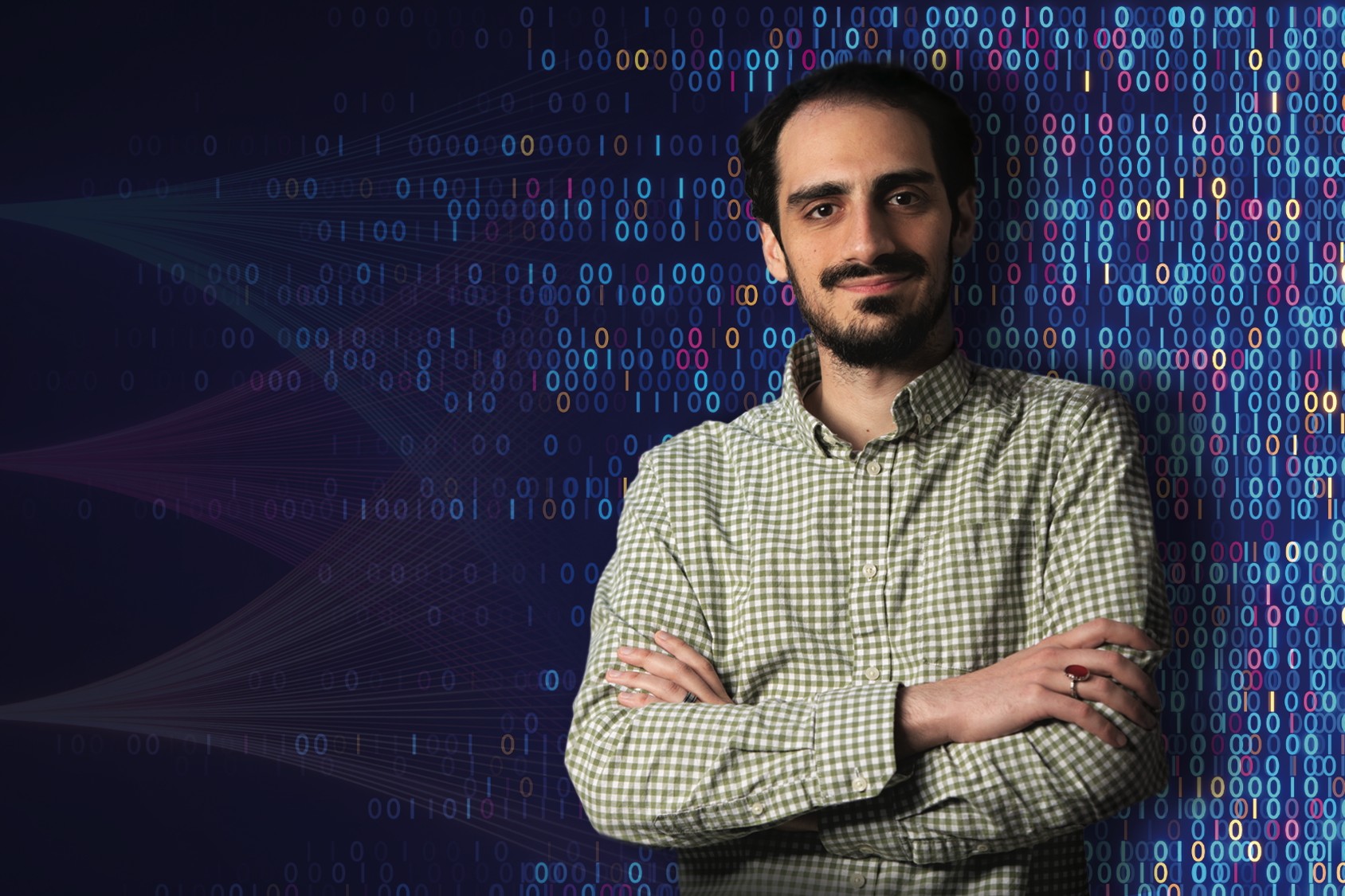
Two years ago, the artificial intelligence tool ChatGPT burst onto the scene. In the short time since, generative AI has upended the ways we produce and share written information, pursue scientific discoveries, diagnose diseases and even create art. The sci-fi-worthy technology is also impacting how we learn – a topic of particular interest to computer scientist and education researcher Shayan Doroudi, UC Irvine assistant professor of education.
He first became curious about artificial intelligence as a computer science undergrad at the California Institute of Technology, when taking an online class about AI. It was the early 2010s, and massive open online courses – which are free and draw thousands of students from around the world – had just made their splashy debut. The class sparked Doroudi’s interest in AI. But it also got him thinking about the power of online education platforms. How, he wondered, might technology make education more effective?
It’s a question he’s been asking ever since. Doroudi went on to intern at a company that produced MOOCs, then earned an M.S. and a Ph.D. in computer science at Carnegie Mellon University in Pittsburgh. His thesis focused on integrating human and machine intelligence to improve curriculum design.
After finishing his doctorate in 2019, Doroudi joined the faculty at UC Irvine, where he heads the Models, Analytics, Technologies, and Histories of Education lab. The acronym, MATHE, is an ancient Greek root that means “learning” – a neat summation of Doroudi’s interests.
“One of the big things I’m thinking about is how we can learn about learning by studying it in both humans and machines,” he says. “Can we use artificial intelligence as a conceptual tool to study how people learn and then use those findings to help us design better educational systems?” Doroudi spoke with The Anteater contributor Kirsten Weir about AI and the questions driving his research.
Some people are excited by AI, while others are nervous about negative impacts such as cheating or spreading misinformation. What do you think?
I think there are exciting potential uses and also a lot of opportunities for these tools to be misused. But this kind of debate isn’t new. Cheating existed before, and misinformation existed before. If history is telling, I don’t think AI is going to drastically change what’s happening in classrooms – for better or for worse. That said, we need to be paying attention and thinking about how to encourage the most productive uses of AI in education.
What are some of the potential benefits and risks of AI in the classroom?
There’s a lot of interest in using AI to tutor kids. But one of the concerns with generative AI tutoring systems is that the AI might start making things up or go off in the wrong direction. It’s hard to guarantee it will behave the way we would want a tutor to behave. But maybe it’s OK if the AI is wrong, depending on how we’re trying to use it.
When would it be OK for AI to make a mistake?
We’re exploring how AI tools could help students learn in a more exploratory way. If a student is stuck, AI might offer several suggestions. Some might be right, some might be wrong, but the student can explore those ideas.
Or AI could give students a starting point to work from. We’re looking at a programming language from the 1960s called Logo that you can use to make shapes and patterns. Logo has been used to explore the intersection of geometry and art, and we’re trying to add an AI component to help students learn geometry in a more exploratory way. Say a student tells the AI to generate code to create a picture of a cat. The AI is good enough to produce something that looks like a cat, but some shapes will be off, or some elements might be in the wrong place. The student can then go in and fix the code. In that kind of application, maybe it’s OK that the AI gets things wrong.
“If history is telling, I don’t think AI is going to drastically change what’s happening in classrooms – for better or for worse. That said, we need to be paying attention and thinking about how to encourage the most productive uses of AI in education.”
Shayan DoroudiUC Irvine Assistant Professor of Education
Are there other ways you’re studying learning in the context of AI?
In one new project funded by the John Templeton Foundation, I’m collaborating with Duncan Pritchard, Distinguished Professor of philosophy at UC Irvine, and Gabe Orona, a postdoctoral scholar in education sciences at the University of Tübingen in Germany.
Professor Pritchard has done a lot of pioneering work studying intellectual virtues such as curiosity, integrity, intellectual humility and intellectual tenacity. We want to know: When high school and college students use generative AI tools, to what extent are they aligned with these virtues?
The most obvious case in which it wouldn’t align is when students aren’t showing integrity, like using AI to write an essay. But there are more nuanced cases as well. One intellectual virtue is intellectual autonomy – thinking for yourself. Ideally, learning is a big part of the undergraduate experience. Students shouldn’t be offloading their thinking to tools like AI, even if they’re using AI in ways that don’t go against course policies.
Do you think we can learn to use AI in intellectually virtuous ways?
In a later part of the project, we plan to look at how we can use AI as a tool to foster learning about intellectual virtues and then to actually change students’ behavior so that they’re displaying those virtues – when using AI and beyond.
In a world where everyone’s thinking about what we can do with AI to increase productivity, I also want to think about how these tools can help us reflect on what it means to be human. AI forces us to think about what makes us unique. What does it mean to have these intellectual virtues? Technology shouldn’t take learning away from us. Hopefully, learning will always be an essential part of the human condition.