IN THIS ISSUE
Anteater Spotlight
Entrepreneurs in Beauty and BusinessFaculty Focus
Herbal Intelligence
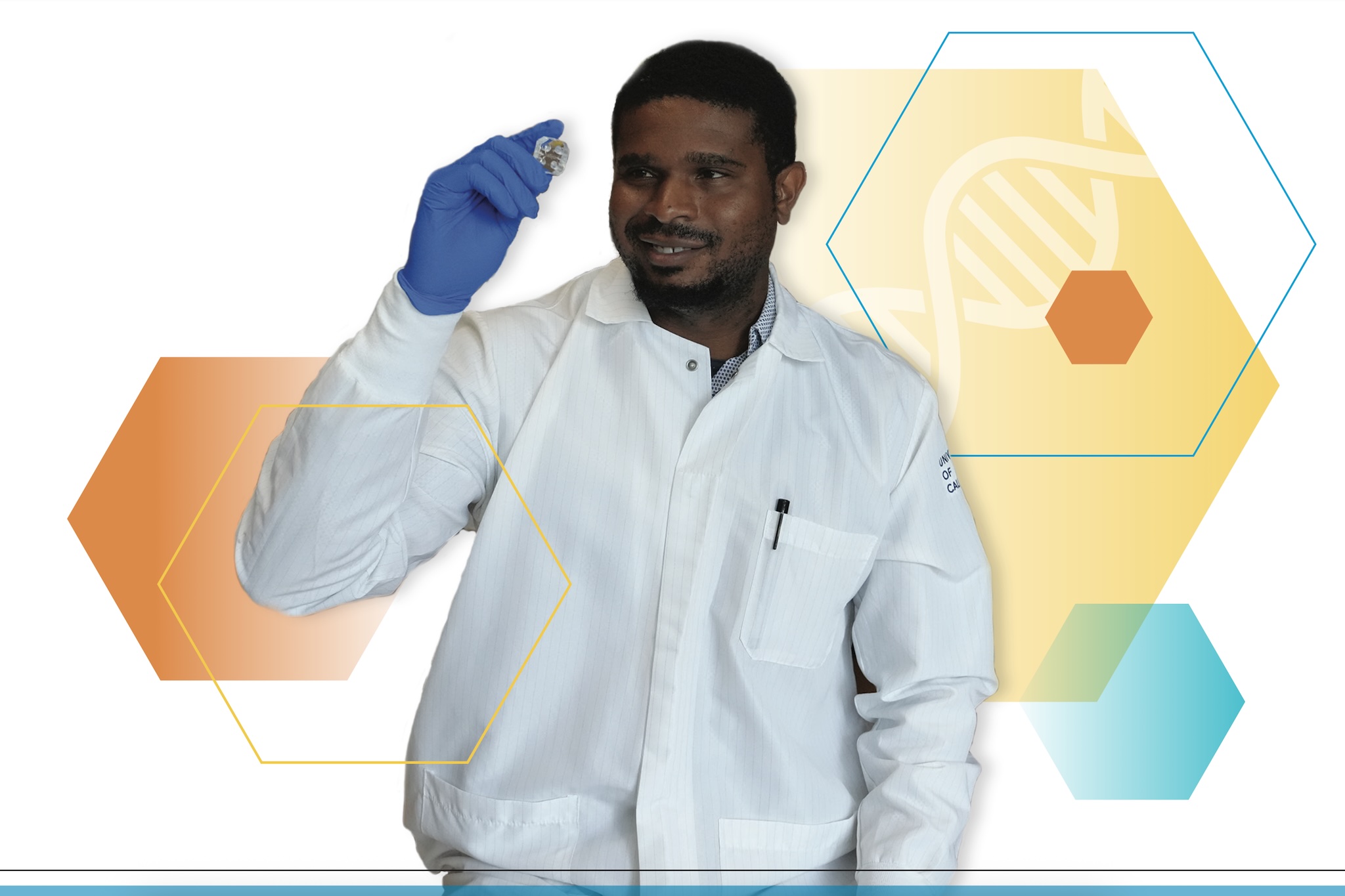
Forget the Petri dish. The two-dimensional medium once essential to biomedical research has gone the way of the landline, at least in Quinton Smith’s lab.
On the second floor of UC Irvine’s Engineering Hall, the assistant professor of chemical and biomolecular engineering instead nurtures stem cells in three-dimensional gel molds to create organs-on-a-chip. These miniaturized, simplified “organoids” mimic the functional, structural and biological complexity of human organs.
“We have this idea,” Smith says. “Can we actually replace animal studies and create a body-on-a-chip to study how tissues interact?”
So far, so good. His work earned him a spot on Popular Science’s recent Brilliant 10 scientists list. Editors said Smith is “on the cusp of changing the world.” He was also named a 2023 Pew Scholar in Biomedical Sciences, a distinction that recognizes early-career scientists and provides four years of funding.
Smith’s lab currently focuses on nonalcoholic fatty liver disease (cirrhosis) and preeclampsia research.
To better understand how human metabolism contributes to liver disease, Smith reprograms skin cells into pluripotent stem cells. Then, with a chemical cocktail, he turns them into liver cells and feeds them a “Western junk food diet” to create the kind of fatty cells present in a diseased organ.
Smith researches preeclampsia by growing stem cells into miniature placentas and studying their interactions with blood vessels on a chip. The approach could lead to the discovery of early biomarkers for the disease. Usually presenting in the 20th week of pregnancy, preeclampsia is characterized by abnormal placenta implantation with a limited vascular supply from the mother, impeding the transfer of nutrients to the fetus.
Now 35, Smith got his start in chemical engineering at the University of New Mexico, graduating in 2007. He earned a doctorate in 2017 at Johns Hopkins University and conducted postdoctoral research at the Massachusetts Institute of Technology.
Arriving at UC Irvine in 2021, Smith has recruited postdocs and grad students who are as excited as he is about interdisciplinary research that blends biology and engineering. He sat down with The Anteater contributor Cathy Lawhon to discuss his pioneering stem cell research.

PSCs are specialized cells that can self-renew forever and can be manipulated to develop into any cell or tissue in the body. They allow us to study patient-specific development and disease causes in a controlled lab setting.
The field is reinventing itself. Microfluidic or chip technology dates back to the semiconductor industry in the early 1990s. But the cool part is leveraging this technology to study cell biology. Stem cell research has evolved too, as we have integrated organoids. Early on, we had this idea that we could take a skin cell, reprogram it to an embryonic state and coax it into becoming a liver cell to eventually grow an organ. However, reprogramming cells is very challenging, and finding the right ingredients to mature them into various adult tissues in the body is an important, exciting research challenge.
They eliminate the ethical concerns of animal studies. But they also give us more control and high precision. A mouse is not a human. For example, we can cure cancer in mice, but we can’t do it in humans. By using human tissues, we can be much more precise.
“[Organoids] eliminate the ethical concerns of animal studies. But they also give us more control and high precision. A mouse is not a human. For example, we can cure cancer in mice, but we can’t do it in humans. By using human tissues, we can be much more precise.”
My work is a marriage of my Ph.D. in vascular research and my postdoc in liver tissue engineering. Hispanic Americans have the highest incidence of fatty liver disease in the United States. Preeclampsia is interesting in that there seems to be a large health disparity based on ancestry. For example, while preeclampsia affects 5% to 8% of all pregnancies, the rate of preeclampsia in African American women is 60% higher. Furthermore, African American women are three to four times more likely to die of pregnancy-related complications in the U.S. than white women, according to the Centers for Disease Control and Prevention. Interestingly, a study from Johns Hopkins found that in Boston, Black women not born in the U.S. had a 27% lower risk of preeclampsia. But Black immigrants who reside in the U.S. for more than 10 years face an increased risk. This research suggests that more than ancestry plays a role in maternal health. There are limited biomarkers for preeclampsia until the 20th week, when the only treatment is to deliver the baby early. We can’t conduct studies on pregnant humans, but we are hopeful we can use stem cells to recapitulate this critical developmental process.
Our approaches are complex and interdisciplinary. We have to understand stem cells, human biology, materials science and engineering micron-sized devices before we can even begin to ask the relevant questions.
It’s interesting that all my mentors have been women, and the best advice came from my mother, who said: “There are people who make excuses and people who make a way.” I had a lot of imposter syndrome. When I applied to grad school, I was wait-listed at first. People will say you can’t do it. Throughout my career, I’ve found a way.
Fierce Conversations, by Susan Scott, talks about negotiation and becoming a leader. As a mentor with two postdocs, seven graduate students and seven undergraduate researchers, I aspire to create a healthy research environment. Communication is important. To do this you need a team. We all stand on the shoulders of giants.